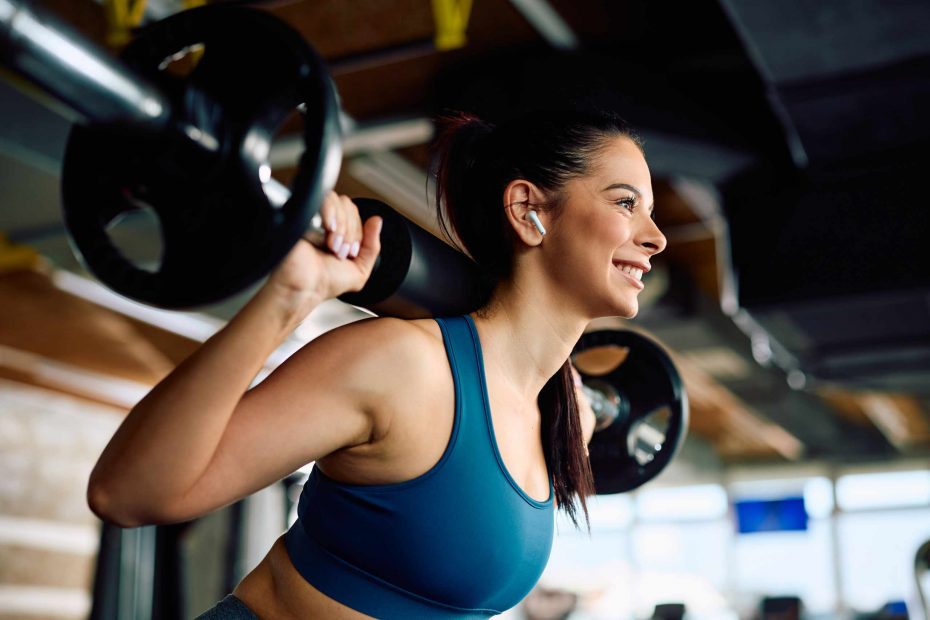
They almost sound a little too easy to do for beginners, especially since you’d think of an exercise as a series of fast reps. However, speed can conceal what you need to practice. For example, you may be able to do several quick squats and you might feel like you’ve completed a squat, but when you slow it down, you might discover that the movement is a little wobbly (your knees are going one direction, your heels are lifting, your trunk is bending forward, etc.).
When slowing a squat down, focus on: • Where your hips are going (back and down). • Where your heels are (planted). • Whether your knees are moving nicely together or drifting out. When you try that slow hip hinge you might learn about the difference between bending at the hip versus bending at the trunk (rounding of the spine). A slower plank helps with the understanding of maintaining tension or bracing through the core, without using momentum to lift your shoulders off the ground or sagging through the lower back.
Try just six slow, controlled reps in place of 15 faster squats. Lower with control, pause briefly at a comfortable depth, then stand up without bouncing. It isn’t just that the reps are slower; you need a chance to pause and notice if you are set up correctly, how your breathing is going, and the ease of the movement. Do the same when you try a slow hip hinge. Start tall, bend your knees just a bit, move your hips back as if you were closing a car door behind you. If you start with your hips too low too fast you might round the trunk to make it work, or the hinge will turn into a squat. The hinge is designed to stretch the back of your legs. You have to practice to feel the hinge through the back, and if you keep the trunk and shoulders steady you may find it a more manageable position. Check a mirror, or put your hands lightly on your hips to find that hinge.
With a plank it is a good idea to just pause and slow it down. If you normally hold a plank until you’re going to start falling and shaking, just practice setting up correctly, and stop as soon as you start noticing signs of fatigue. Press your hands into the floor and keep your neck neutral, make sure you’re breathing, not holding tension in your face, and stop as soon as you start to notice a sag in your hips. A shorter plank with clean alignment is more valuable for your training because the position is cleaner and you don’t get in the habit of compensating (holding tension in your face and shoulders) to get to the bottom line.
For those of you out there, who think slow training is not working hard enough, try this. A slow movement is going to give you a more honest assessment as to where the limits of the training are. It reveals more about where you need practice and if your breathing becomes constrained, or where it would benefit from a modification (pushups on an elevated surface, box squats, shorter plank holds, smaller ranges of motion on your hip hinge) to improve your practice without it being a struggle to get it done.
A good sign for learning a skill is you can describe the movement. It’s easier to tell where your feet are as you go, where your hips are moving, when to breathe, how you are set up, and whether you are maintaining good form or letting it slip. Once you have those skills down, then you can build the intensity up and do more sets, or move up to a slightly more challenging position. Until then, your slow reps will give you more information on what your body is doing than you’d find if you only focused on speed.